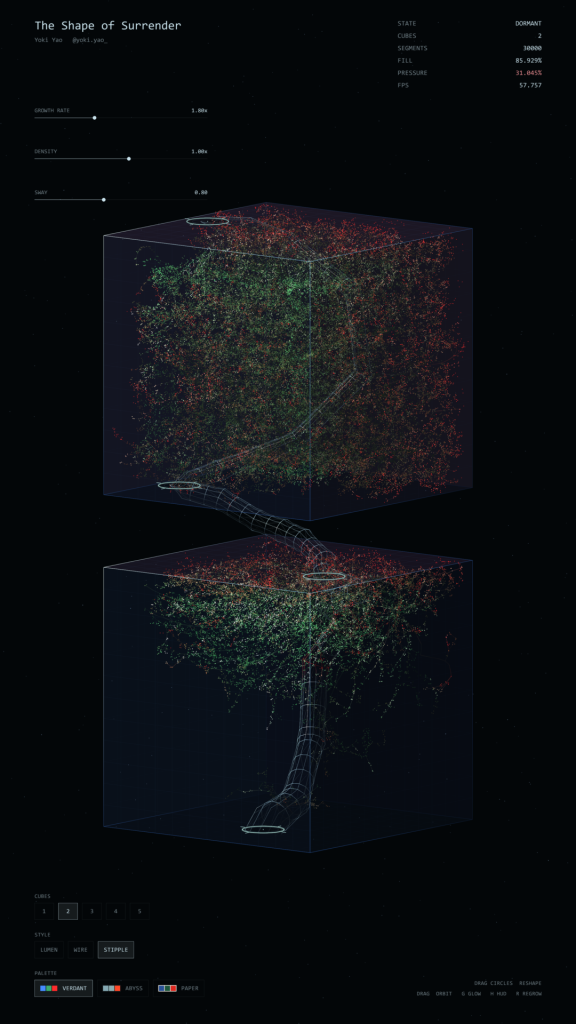
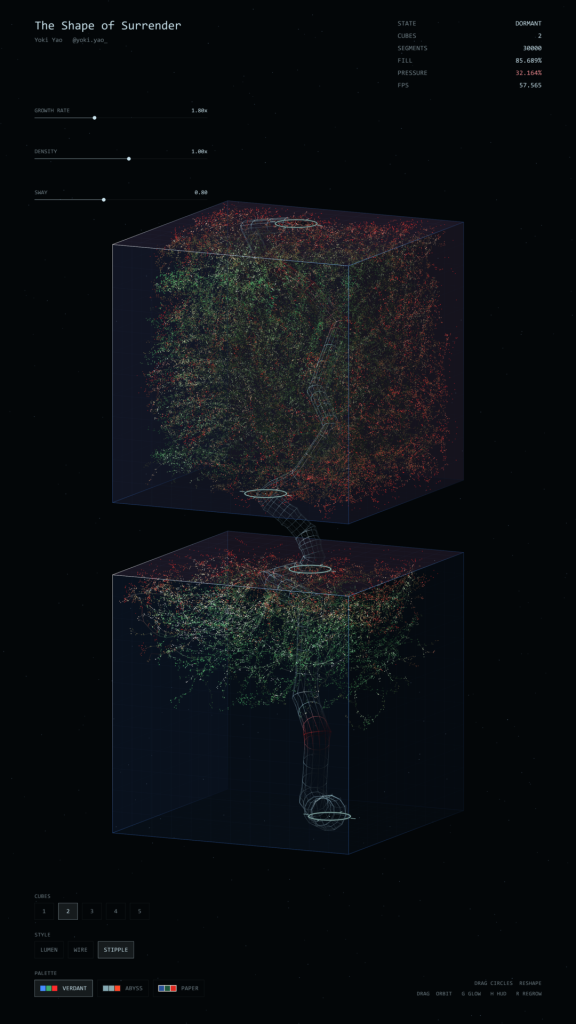
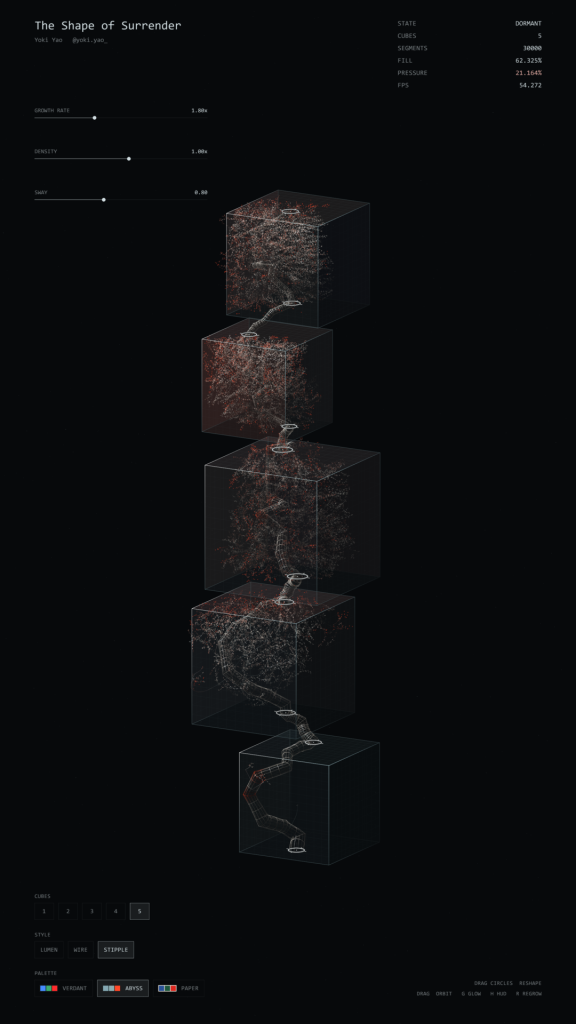
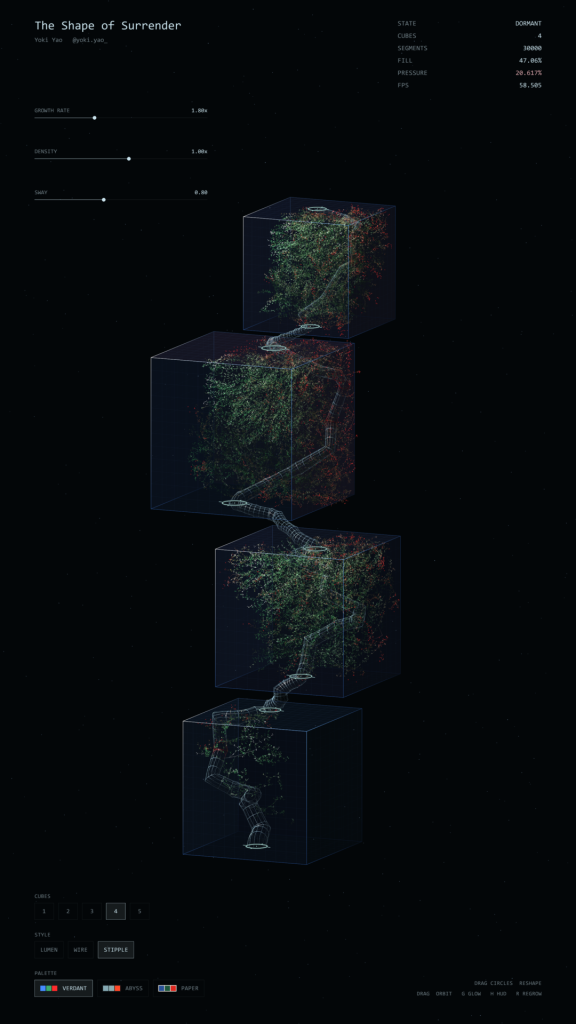
The Shape of Surrender is an interactive generative sculpture exploring the relationship between organic growth and imposed spatial constraints.
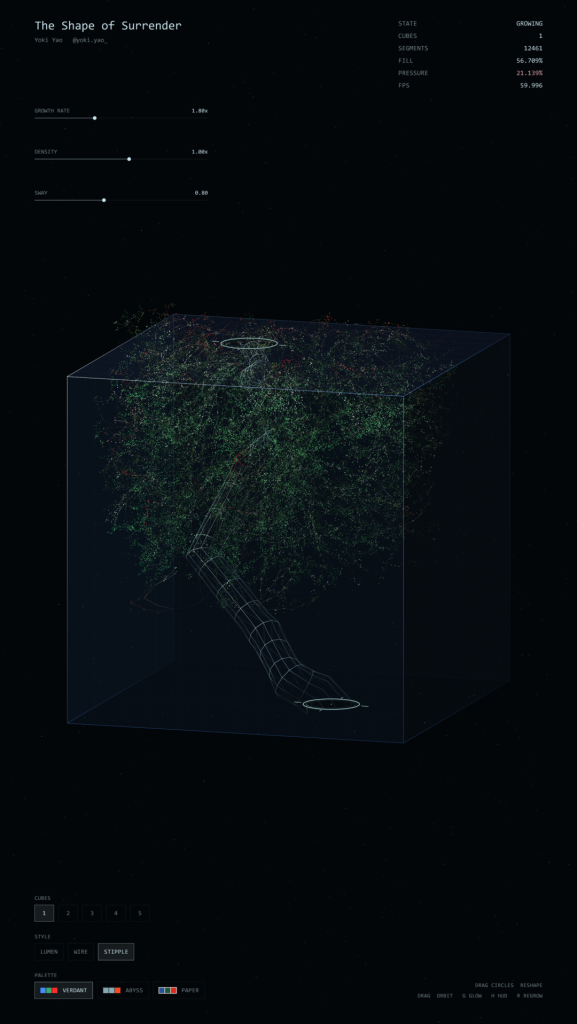
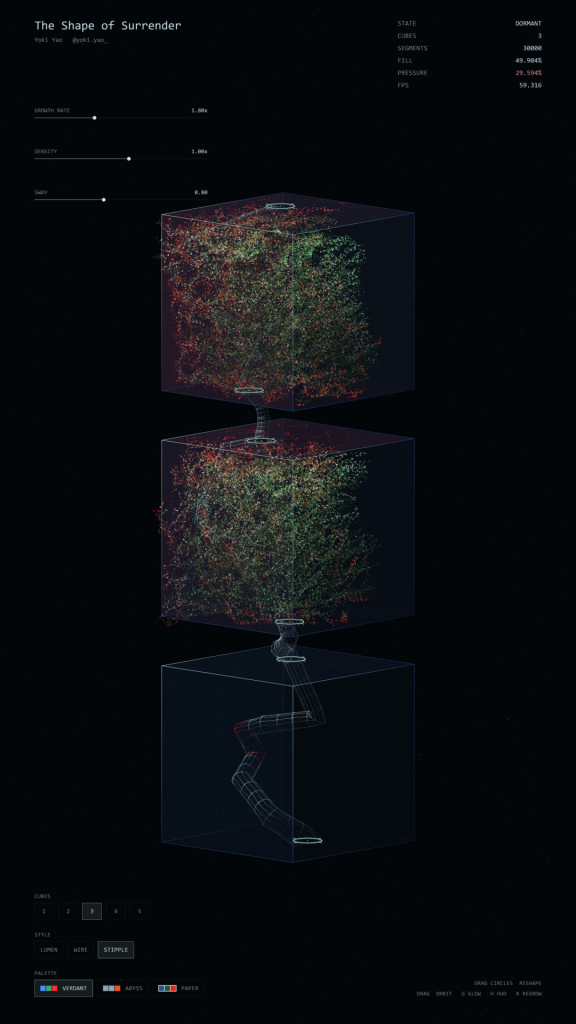
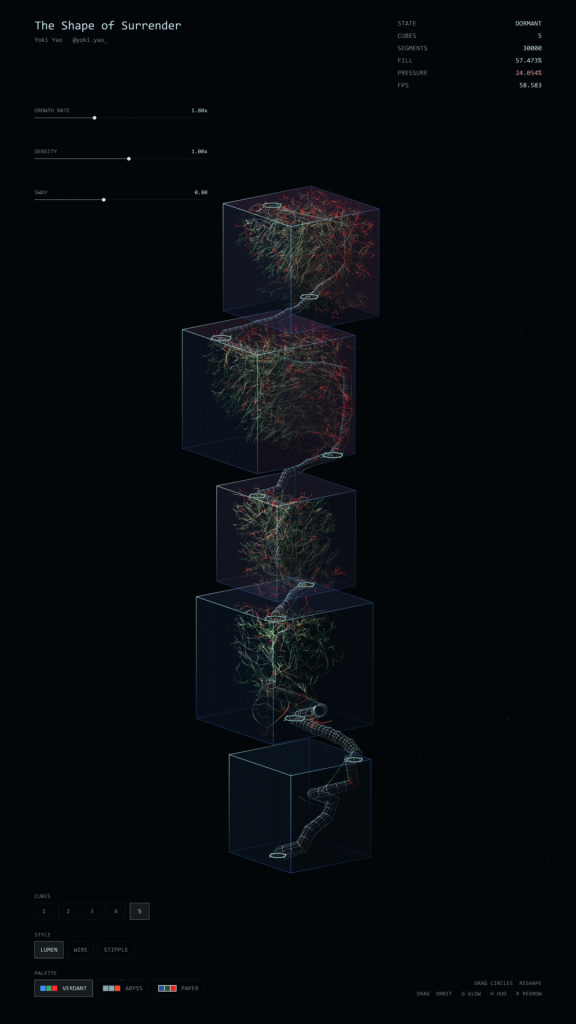
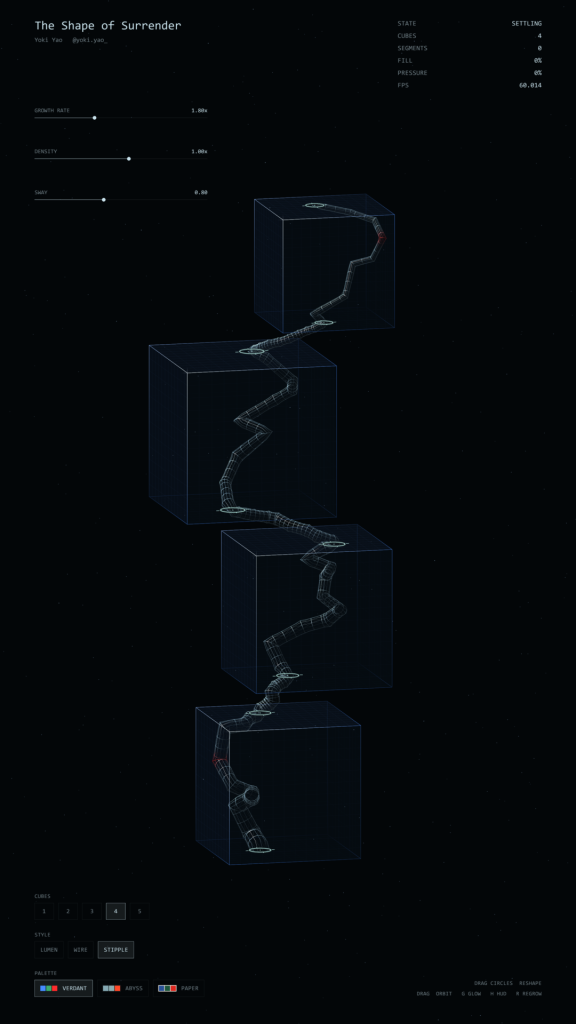
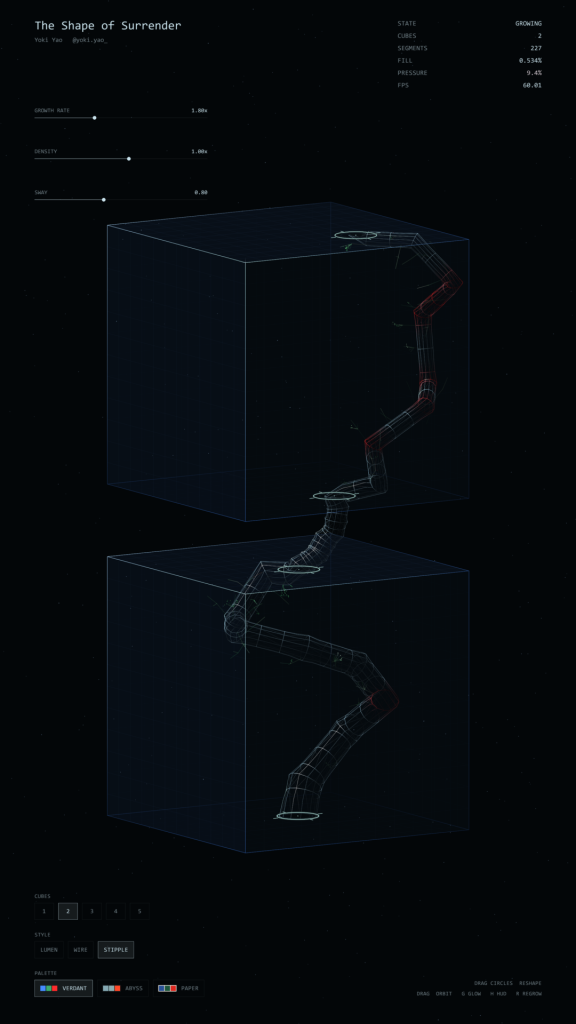
A virtual tree grows within a series of one to five vertically arranged cubic enclosures, its continuous trunk connecting the otherwise isolated spaces. Viewers can adjust the number of cubes and manipulate the trunk’s anchor points, altering its underlying structure. Once the interaction ends, the tree begins to grow autonomously, generating branches that expand, encounter boundaries, and redirect themselves to occupy the available space.
Where it cannot go, it learns to bend. Where it cannot bend, it waits.
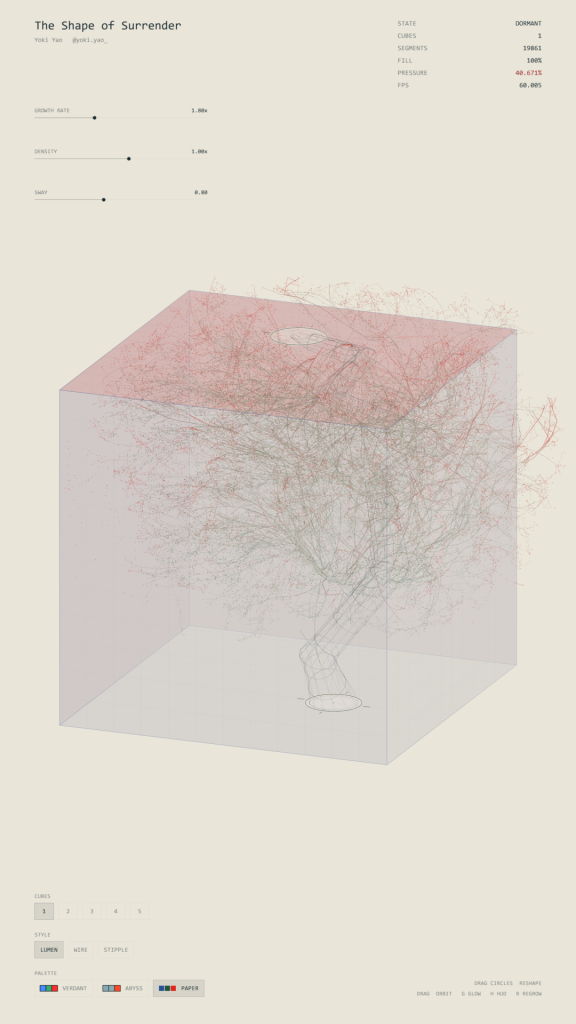
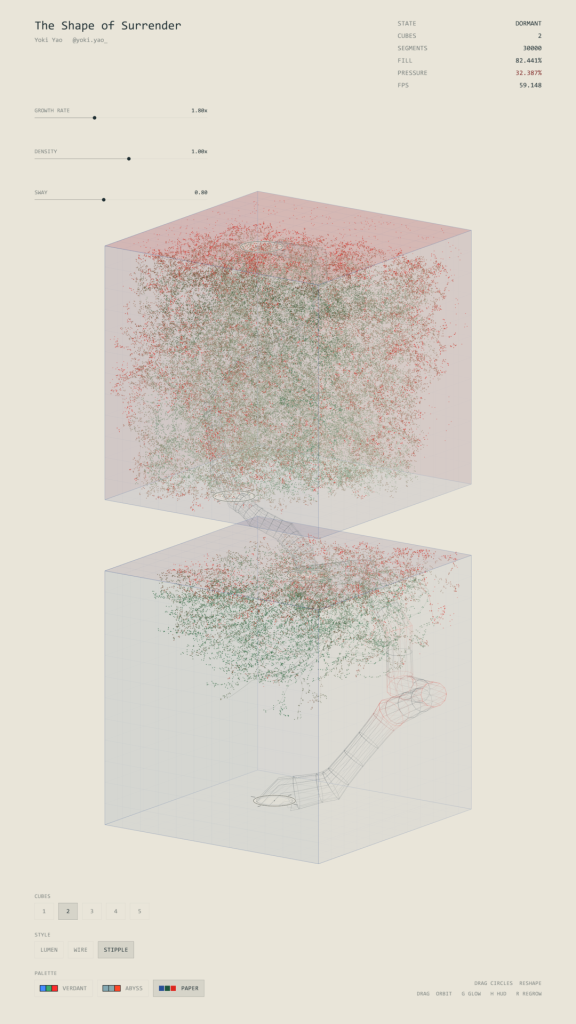
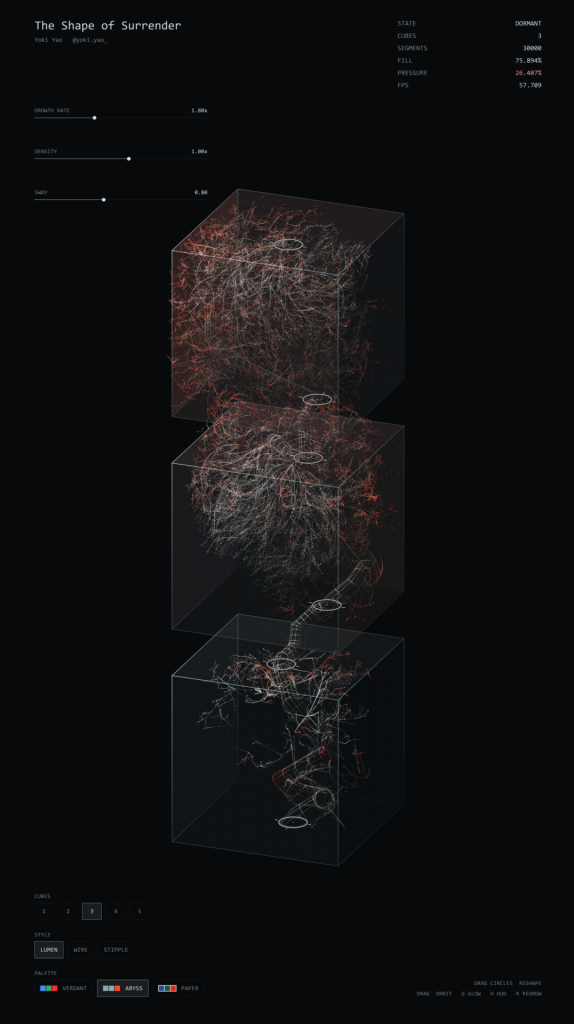
As growth continues, the organic structure gradually assumes the geometry of its confinement. Areas subjected to greater spatial resistance turn red, suggesting pressure, discomfort, and the physical consequences of adaptation. What emerges is a delicate contradiction: the tree flourishes, yet the more it grows, the more closely it resembles the boundaries that confine it.
Each new intervention erases the previous growth, initiating another cycle of formation and adaptation. Through this recurring process, the work examines how external structures shape living forms, and questions the ambiguous relationship between adaptation, control, and the loss of autonomy. The tree neither escapes nor ceases to grow. Its final form becomes both a testament to its resilience and a quiet record of everything it has had to surrender in order to survive.
Interaction
Viewers are invited to shape the tree’s growth through an interactive interface. They can select between one and five cubic enclosures and drag the circular anchor points to reshape the continuous trunk, exploring different structural possibilities.
When the interaction stops, the tree begins to grow autonomously, gradually filling the available space. Any new manipulation causes the existing branches to disappear, initiating another cycle of growth and adaptation.
Viewers can adjust the growth rate, branch density, and natural swaying motion, as well as explore different visual styles and colour palettes. The three-dimensional structure can be rotated and observed from different perspectives, revealing how the tree responds to its spatial boundaries.
Through these interactions, viewers become both the creators of the tree’s conditions and witnesses to its struggle to adapt.
Inspiration
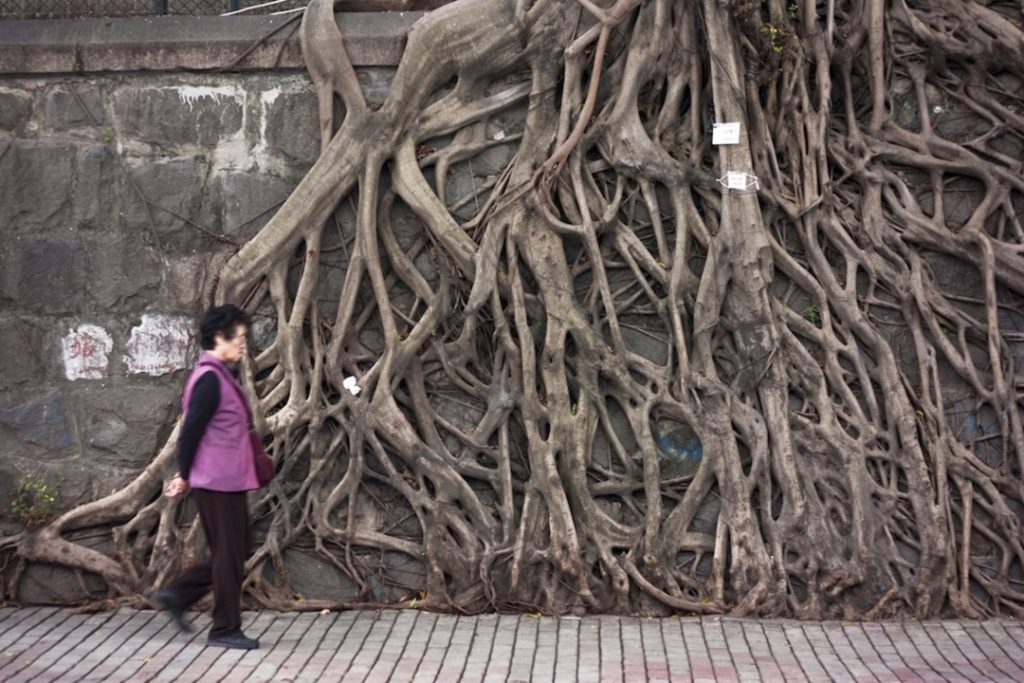
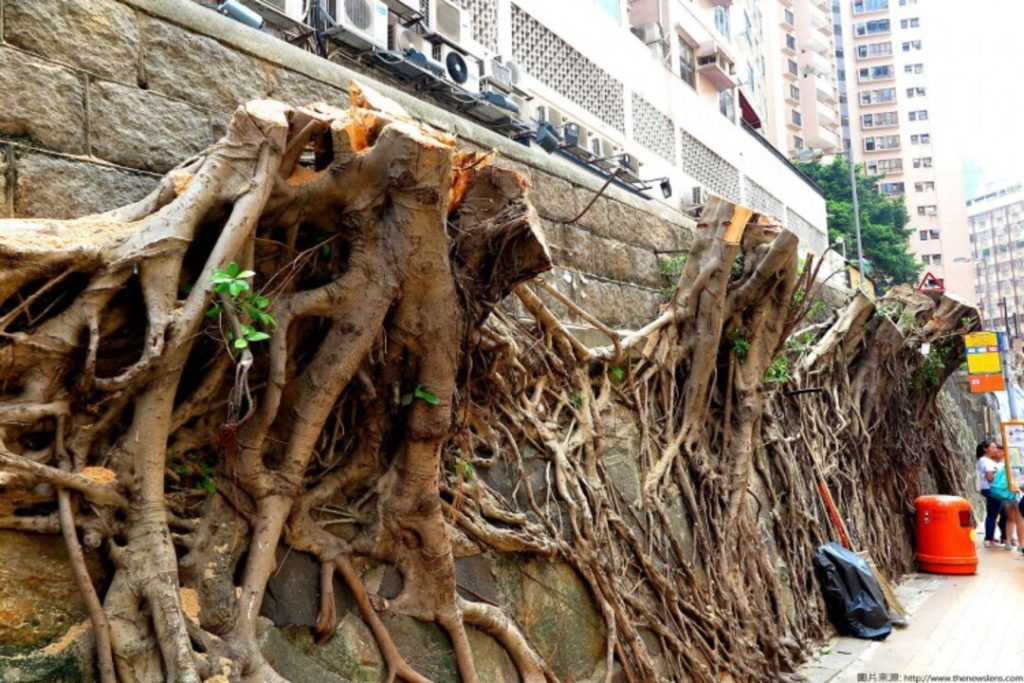
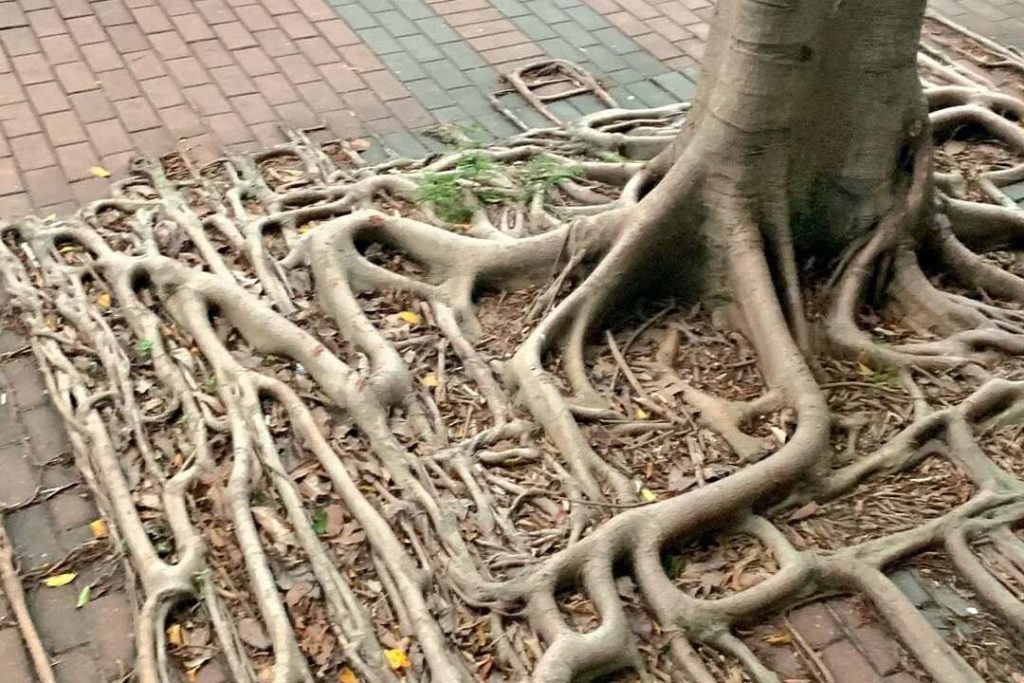
The Shape of Surrender began with observations of plants growing within the urban landscape of Hong Kong.
Tree roots trace the edges of pavement bricks, bending around the rigid geometry of the city. Trees emerge from walls, finding ways to survive in spaces never intended for them. Weeds grow quietly through cracks in concrete, only to be abruptly cleared away. In villages, even decades-old trees can be cut down simply because they stand in the way of a parking space.
These encounters reveal a quiet contradiction in the relationship between nature and the built environment. Plants continuously adapt to the structures we impose upon them, reshaping their bodies around our buildings, roads, and boundaries. Yet their persistence is rarely met with the same willingness to accommodate them.
We expect nature to make room for us.
The work translates these observations into a virtual environment, where a tree is given space to grow, but only within boundaries determined by others. Its branches bend, turn, and press against the limits of their enclosure, gradually taking the shape of the space they inhabit.
What appears as an elegant geometric form is also a record of countless compromises — a quiet reflection on the beauty, resilience, and vulnerability of life growing in places that were never made for it.